CanYourChildwithEczemaAttendSwimmingLessons?HowtoKeeptheSkinCalminChlorinatedWater[2026]
![Can Your Child with Eczema Attend Swimming Lessons? How to Keep the Skin Calm in Chlorinated Water [2026]](/_next/image?url=https%3A%2F%2Fzvblogpostimages.s3.eu-west-3.amazonaws.com%2FAUTOMATISCH_UPLOAD%2F1_8a1034cfebd6.jpg&w=3840&q=75&dpl=dpl_GdzwTp1HD8avZ8Ec58gCSaBRDhLZ)
Summary
- Yes, a child with eczema can usually attend swimming lessons: swimming is a life skill no child should miss.
- Chlorine is not automatically an enemy. Dermatologists even use diluted chlorine as a treatment for eczema, the well-known bleach bath.
- Apply a greasy ointment before the lesson as a protective layer, shower after the lesson with a soap-free gel, and reapply ointment afterward.
- Skip the lesson during severe flare-ups or infected, weeping skin and consult the GP.
- Worldwide, 10 to 20 percent of children have eczema. The same care rules apply in every pool, in every country.
The short answer: usually just go to the lesson
Your child has eczema and swimming lessons are coming up. You might wonder if the chlorinated water will irritate the skin further, or if you should let your child go. The short answer: yes, in most cases a child with eczema can simply attend swimming lessons. According to Thuisarts, the website of the Dutch General Practitioners Association NHG, eczema treatment in children revolves around moisturizing, gentle showering, and minimal soap use. These habits determine how well swimming lessons go, because the same applies in the pool: care for the skin, don’t avoid it.
Below you’ll read how chlorine affects eczema-prone skin, what to do before and after the lesson, and when skipping is the wiser choice. The rules are the same in every pool, in every country.
Why this question concerns so many parents
Eczema is not a rare condition affecting only a few. It is one of the most common skin diseases in children worldwide, with similar prevalence numbers in almost every country.
Eczema is the most common childhood skin condition worldwide
According to the National Eczema Association, an estimated 10 to 20 percent of children worldwide have eczema, also called atopic or constitutional eczema. In a swimming lesson group of eight children, it’s likely that one child has sensitive skin. When you hear parents on the sidelines say children are not allowed to swim because of their skin, it’s mostly a persistent misconception.
A skin that loses moisture more quickly
With eczema, the skin’s protective barrier works less effectively, explains Thuisarts. Moisture evaporates more easily and external irritants penetrate more readily. This causes the skin to dry out quickly, tighten sooner, and itch more easily. Healthy skin has a slightly acidic surface with a pH of about 4.1 to 5.8. Pool water has a pH of 7.2 to 7.4, well above that, describes a review study in the journal Pediatric Dermatology. This makes moisturizing not a luxury, but the core of the approach.
Is chlorine bad for eczema? Less black-and-white than you think
Chlorine sounds like the opposite of caring for vulnerable skin. The reality is more nuanced, and that nuance determines whether your child enjoys swimming for years or stays home on the couch.
Chlorine can irritate, but not for every child
Pool water can dry out or irritate the skin of some children with eczema, writes the British National Eczema Society. High pH or high calcium content in the water increases dryness, and a few children react to chlorine itself with contact eczema. For others, nothing happens. Eczema is an individual condition: one child feels nothing from the pool, another gets dry, red skin after every visit. The key is to find out how your child reacts, not to stop in advance.
Diluted chlorine is also a treatment
The surprising fact: dermatologists sometimes prescribe diluted bleach baths for eczema. A small amount of chlorine in bathwater kills bacteria on the skin and can reduce flare-ups. Harvard Health draws the comparison: a chlorinated pool is essentially a very large, very diluted bleach bath. Many children actually feel calm in the water, not irritated. Pool water is much weaker than a treatment bath, so you shouldn’t expect a chemical reaction from the pool itself.
What research says about swimming and eczema
The 2023 review study gathered all available research and drew two reassuring conclusions. Large birth cohorts, including the British Avon study, found no link between swimming at a young age and later development of eczema. And the temporary effect on the skin is limited: in young elite athletes, skin moisture loss increased only after two hours of intensive swimming and recovered within half an hour. A regular swimming lesson of half an hour to 45 minutes is well below that.
The same research found a clear signal about aftercare: German researchers had babies swim weekly and applied a greasy ointment to one group afterward. That group maintained stable skin, while the group without ointment showed visible skin deterioration after four weeks. The authors’ conclusion is clear: children with eczema should not be sidelined from swimming lessons, because swimming is a life skill. Up to a third of children with eczema have less access to swimming due to disease severity, and that is exactly what you want to prevent.
Before the swimming lesson: how to prepare the skin
A swimming lesson with eczema doesn’t start at the pool’s ticket counter, but at home at the kitchen table. With four habits, you prevent most of the trouble.
A greasy ointment as a protective layer
Apply a greasy ointment to your child before swimming, preferably petroleum jelly based. Harvard Health calls this a grease-up: a greasy layer that shields the skin from the water. Apply thinly on the palms and soles, because your child still needs to hold onto the edge. Be honest about the risk: a thickly greased skin is slippery. If your child can’t swim well yet or an instructor will need to assist in the water, apply only a thin layer or wait until after the lesson, and discuss safety with the instructor. The British National Eczema Society also warns about this: a slippery child is harder to rescue. If you’re unsure which ointment is suitable, ask your GP or dermatologist.
A new pool: test briefly first
Every pool maintains its water differently. One facility doses chlorine, another uses salt chlorination, bromine, or a combination. When trying a new pool, start with a short lesson or a brief swim and observe how the skin reacts. Timing also matters: right after chlorine dosing, concentration is highest, so an early morning lesson is often gentler on sensitive skin than one just after maintenance. Feel free to ask at reception; pools usually share this information.
Clothing and gear that help
A silicone swim cap and goggles with silicone seals irritate less than rubber versions. For children who feel self-conscious about their skin, there are UV-protective swimsuits with long sleeves and legs, which also provide sun protection. Rinse all swim gear after the lesson, because dried chlorine on a swim cap acts as an irritant next time.
After the swimming lesson: aftercare makes the difference
What happens in the ten minutes after leaving the water largely determines how the skin looks in the following days. Dermatologist Marjolein Leenarts outlines the sequence.
Shower with fresh water and without foaming soap
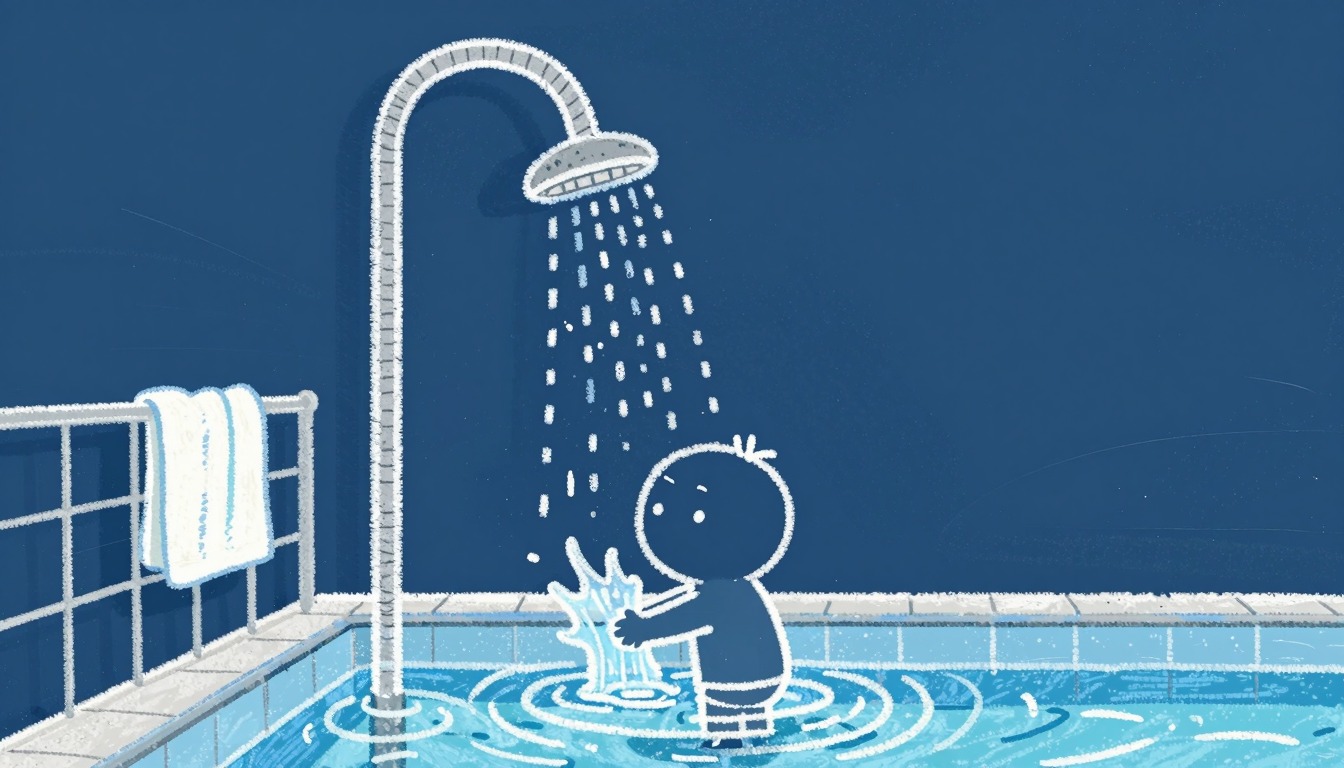
Shower your child as soon as possible after the lesson to rinse chlorine off the skin. Do not use foaming shower gel, as soap removes the natural skin oils you are trying to protect. A shower oil or soap-free shower cream works without stripping the skin. Also pay attention to where you shower: if the pool showers use chlorinated water, it’s better to rinse again at home.
Pat dry instead of rubbing
After showering, dry the skin by gently patting with a clean towel. Rubbing may feel efficient but damages the already vulnerable top layer. Bring a fresh towel from home, preferably not the same one used to dry your child after swimming.
Apply ointment again within a few minutes
Immediately after patting, while the skin is still slightly damp, apply a greasy ointment based on petroleum jelly. This layer locks moisture into the skin and restores a protective film. The American Academy of Dermatology AAD advises exactly this order: rinse with lukewarm water, pat dry, and apply ointment immediately. This is also the moment when the German baby study saw the difference: children who were moisturized after swimming maintained healthy skin; those who were put straight in the car did not.
And in the evening: skip a shower
After a swimming day, the skin has already been washed enough. An extra shower or bath in the evening only dries it out further. A washcloth with water at the sink is enough that evening, as old-fashioned as that sounds.
When should you skip the lesson?
There are situations where going to the pool really isn’t a good idea. Fortunately, these are easy to recognize.
During a severe flare-up
If eczema is in a strong flare with large red, scaly, or raw patches, the skin needs rest. The authors of the review study advise postponing swimming during severe flare-ups. A mild flare is no problem and can be managed with extra moisturizing during the lesson.
With weeping or infected skin
If eczema becomes wet, crusty, or smells unpleasant, a bacterial infection may be involved. Swimming should be avoided then, also to protect others: open skin spreads bacteria more easily through water and towels. Wait until the skin is closed and treatment has taken effect, and consult your GP about when your child can return. The same applies for fever or if your child simply feels too ill; the same rule applies as with any other illness.
Unsure? Ask
The line between manageable and skipping isn’t always clear. When in doubt, call your GP or dermatologist who knows your child’s eczema. Write down how the skin looked in recent days and how your child reacted to previous swims. With that information, the answer is usually clear quickly.
What does this mean for the swim school?
For instructors, eczema is not a rare special case but daily practice. Almost every group has a child with sensitive skin, and those children have the right to the same swimming lessons as everyone else.
Ask about care, not medical details
A parent who says their child has eczema usually doesn’t need special treatment, just some understanding. Ask if the child is moisturized before the lesson and if time is needed afterward to shower and reapply ointment. Don’t make a fuss about it: children with eczema often face their skin condition, swimming lessons don’t need to be an extra spotlight.
Watch for molluscum contagiosum on eczema skin
Children with eczema get molluscum contagiosum more often, and swimmers catch them more easily anyway. Molluscum is not a reason to exclude a child: cover open bumps with a waterproof plaster and ensure towels are not shared. More about recognizing and covering is in the overview of molluscum contagiosum in children.
Keep track of progress, even on off days
A child who skips a lesson due to a flare-up doesn’t have to fall behind. Via the free Swimmigo app for parents you can report the absence and schedule a make-up lesson, and the instructor tracks skills and levels, so nothing is lost. Swim schools use the same app to keep groups, progress, and communication organized, also for children who occasionally miss a lesson. The complete story about health and swimming is in the overview of swimming and health for children.
Conclusion
Eczema is not a reason to skip swimming lessons. For most children, chlorinated water is perfectly compatible with good skin care, and diluted chlorine even soothes many eczema skins. The sequence is simple: a greasy ointment before the lesson, shower with a mild gel afterward, pat dry and reapply ointment. Only during severe flare-ups or infected skin do you pause and consult the GP. This way your child safely learns to swim, in every pool, in every country.
Sources
- National Eczema Association: Eczema Facts, accessed September 2026
- National Eczema Association: Swimming with Eczema, What You Should Know Before You Take the Plunge, accessed September 2026
- National Eczema Society (UK): Swimming and Eczema, accessed September 2026
- Harvard Health: Swimming and skin, what to know if a child has eczema, May 15, 2023
- O'Connor et al.: Pooling the evidence, a review of swimming and atopic dermatitis, Pediatric Dermatology, 2023
- American Academy of Dermatology: Will swimming in a pool trigger my child's eczema?, accessed September 2026
- Thuisarts (NHG): My child has eczema, last updated May 28, 2026
- Drs. Marjolein Leenarts, dermatologist: Swimming and dry skin, updated August 14, 2024

Bob van Soest
As an expert in operating sports facilities (such as swimming pools) and developer of, among others, Swimmigo.com, I am passionately committed to making swimming lessons simpler, more fun and more insightful for parents, swimming instructors and everyone who wants to learn to swim.
Frequently Asked Questions
Related articles
![Swimmer's Ear in Children: How to Prevent Ear Pain After Swimming Lessons [2026]](/_next/image?url=https%3A%2F%2Fzvblogpostimages.s3.eu-west-3.amazonaws.com%2FAUTOMATISCH_UPLOAD%2F1_c46e581d096a.jpg&w=3840&q=75&dpl=dpl_GdzwTp1HD8avZ8Ec58gCSaBRDhLZ)
Swimmer's Ear in Children: How to Prevent Ear Pain After Swimming Lessons [2026]
Swimmer's ear is an inflammation of the ear canal that often occurs after swimming. Here's how to recognize it in your child, prevent it, and treat it. [2026]
![Can My Child with Asthma Swim? How to Approach Swimming Lessons Safely [2026]](/_next/image?url=https%3A%2F%2Fzvblogpostimages.s3.eu-west-3.amazonaws.com%2FAUTOMATISCH_UPLOAD%2F1_f517784b370a.jpg&w=3840&q=75&dpl=dpl_GdzwTp1HD8avZ8Ec58gCSaBRDhLZ)
Can My Child with Asthma Swim? How to Approach Swimming Lessons Safely [2026]
Can your child with asthma swim? Yes, usually. Here’s how to approach swimming lessons safely: doctor’s advice, medication, chlorine smell, and what the instructor needs to know [2026]
![Complete Overview of Swimming and Health for Children: How to Keep Your Child Healthy In and Around the Pool [2026]](/_next/image?url=https%3A%2F%2Fzvblogpostimages.s3.eu-west-3.amazonaws.com%2FAUTOMATISCH_UPLOAD%2F1_babb0737688b.jpg&w=3840&q=75&dpl=dpl_GdzwTp1HD8avZ8Ec58gCSaBRDhLZ)
Complete Overview of Swimming and Health for Children: How to Keep Your Child Healthy In and Around the Pool [2026]
Swimming is healthy for children but also has risks: swimmer's ear, warts, chlorine smell, and stomach flu. Here's how to keep your child healthy in and around the pool [2026]
Discover Swimmigo
The all-in-one app for swimming lesson progress. For parents, swim schools, and adult swimmers.