SwitchingSwimmingSchools:HowtoManagetheTransferWithoutLosingLevel[2026]
![Switching Swimming Schools: How to Manage the Transfer Without Losing Level [2026]](/_next/image?url=https%3A%2F%2Fzvblogpostimages.s3.eu-west-3.amazonaws.com%2FAUTOMATISCH_UPLOAD%2F1_83c928f52559.jpg&w=3840&q=75&dpl=dpl_GdzwTp1HD8avZ8Ec58gCSaBRDhLZ)
Summary
- Moving is the most common reason to switch swimming schools: 1.75 million people moved in the Netherlands in 2025.
- Obtained diplomas remain valid because the National Swimming Diplomas A, B, and C are the same document nationwide.
- Every school reassesses a new student because swimming schools use their own teaching methods and intermediate levels.
- Bring diplomas and a progress overview so the new school knows exactly what your child can already do.
- Always ask about the NRZ license and the instructors’ diplomas during an intake.
Switching swimming schools happens more often than you think. A move, dissatisfaction with the pace, lesson times that no longer fit. And the same question always arises: does my child have to start over? Almost never is that necessary. Whether the transfer goes smoothly mainly depends on one thing: how well you can show what your child already can do.
Obtained diplomas remain valid nationwide. And a good swimming school determines the entry level with an intake in the water, not by guessing. Yet many things go wrong during transfers, usually because parents don’t know what to look out for. Below are the steps that work, from the first conversation to the last lesson at the old school.
Why Parents Switch Swimming Schools
Moving is the most common reason. The CBS counted 1.75 million people who moved in the Netherlands in 2025, and most people move during the summer months. Exactly the period when swimming schools organize their groups for the new season.
The second big reason has nothing to do with moving. Parents see their child doing the same thing for months, receive little feedback, or notice that the group dynamic doesn’t fit. In the explanatory notes for the Swimming Skills Act the Dutch House of Representatives states that a quarter of surveyed parents felt their child had not learned to swim well enough.
Moving, the Most Common Reason
Those who move to another municipality usually cannot stay at the same school. Of the 1.75 million people who moved in 2025, over 830 thousand moved to a different municipality, according to the same CBS figures. July and August are the busiest months. Many swimming schools start fresh groups in September, so those who arrange it on time can join almost immediately.
Moving abroad is a different story. Different diploma systems exist there or sometimes no national standard at all. What your child learned here cannot simply be converted into a local diploma. An overview of concrete skills then becomes more valuable than the certificate itself. More on that later.
Dissatisfaction with Pace or Approach
Not every transfer starts with a moving box. Sometimes it just doesn’t work: the child has been at the same level for months, lessons feel repetitive, or communication with the school is disappointing. Practical points also matter, such as lesson times, travel time, or a group that just doesn’t fit.
These are all valid reasons. Swimming lessons are a multi-year process, and the connection between child, instructor, and school largely determines whether that process remains enjoyable. Switching is allowed, even without big drama.
Obtained Diplomas Remain Valid
The first thing you need to know when transferring: a diploma does not expire. The National Swimming Diplomas A, B, and C are issued nationwide by the National Council for Swimming Safety (NRZ). Only swimming schools with an NRZ license may issue these diplomas, and the exam requirements are therefore fixed throughout the country.
What A, B, and C Mean
Swimming diploma A covers skills in a pool without attractions: floating, orienting underwater, swimming a short distance. Diploma B adds a pool with attractions, such as a slide or wave pool. Diploma C is considered the National Swimming Safety Standard and also covers open water without currents, such as a recreational lake.
A child who has obtained A never has to prove again at a new school that they are at A level. The diploma is nationally recognized and remains so, wherever you move.
Why Schools Still Use Their Own Level Ladder
There is a lot of material between the diplomas, and that is where schools differ. One school works with colors or pools, another with stamps or back numbers. These intermediate levels are not nationally standardized and only mean something within the own school.
As a result, a child who was at the highest level at the old school may enter a few steps lower at the new school, even though their skills have not declined. Annoying, but normal; it says nothing about your child.
Why Every Child Is Reassessed at a New School
Schools use their own systems because swimming instruction in the Netherlands is a free profession. In the explanatory memorandum for the Swimming Skills Act, the House of Representatives explains that anyone may give swimming lessons and issue diplomas with self-determined requirements. Since 1984, the NRZ has provided a quality framework via its license, but not every provider falls under this.
The same parliamentary document shows that parents know little about this: 84 percent are unaware that not every swimming instructor has an instructor diploma, and 70 percent do not know that a quality mark is not mandatory. A transfer is therefore also a good moment to ask questions you may never have asked at the first school.
The Intake Is an Introduction, Not a Re-exam
A school that frequently receives transfers does not let a child enter based on self-declaration. Zwemschool Utrecht tests children on the skills they have learned so far and then makes a plan with the parents towards the final exam. This is how it works in many places: the child shows what they can do in the water, the instructor observes, and together you decide where to go from there.
Do not see the intake as an exam. It is an introduction, for the child and for you.
How to Recognize a Good New School
- They ask about obtained diplomas and what has been practiced in recent months.
- They let your child show what they can do in the water and look at skills rather than the level at the previous school.
- They explain how the starting level is determined and how the first weeks are evaluated.
- They give your child time to get used to a different instructor and new classmates.
How to Approach the Transfer in Five Steps
With this step-by-step plan, you keep control yourself, from the first conversation to the last lesson at the old school.
Step 1: Write Down Why You Are Switching
Do you want smaller groups, a calmer pace, or more challenge? By writing down your reason, you prevent running into the same problem at the new school after three months. Bring your list to the introductory meeting and check if the school has an answer.
Step 2: Check the School’s License
Ask if the school has an NRZ license and if the instructors have a recognized swimming instructor diploma. A school that is open about this has nothing to hide. On the NRZ website, you can check yourself whether a provider really has the license.
Step 3: Schedule an Intake or Trial Lesson
Most schools offer a trial lesson, especially for children who are already advanced. Let your child participate, stay if possible, and pay attention to how the instructor explains and corrects. Such a lesson tells you more than any brochure.
Step 4: Bring Proof of Progress
Diplomas are just the start, but halfway through the process they say little. Ask the current school for an overview of practiced skills, for example from their student tracking system. Also write down yourself what your child does well and what is still challenging, such as head underwater, floating, or backstroke swimming.
Step 5: Properly Close the Chapter at the Old School
Check the notice period in the agreement; usually it is one month. Also see if there are paid lessons still open. Some schools refund credit, others do not. Finally, ask if the school can send a short transfer note; a few lines about the level help the new instructor get started.
What the New School Should Know About Your Child
The more the new school knows, the better the first weeks go. At least mention the following:
- the level: obtained diplomas, but also what has been practiced since;
- what goes well and what is challenging, such as head underwater or backstroke;
- why you are switching; some schools like to hear that;
- medical considerations, such as asthma, sensitive ears, or dry skin;
- how your child learns: do they pick things up quickly, or do they need repetition and encouragement?
Questions to Ask in the First Conversation
Also ask questions yourself. How large are the groups and who teaches the lessons? How long does a child usually stay at a level? How do you track progress, and can parents view it themselves? What happens with cancellations and illnesses, and how does make-up work? The answers say more about a school than the website text.
How to Prevent the First Lesson from Being Stressful
Don’t announce the transfer weeks in advance; a few days is enough. Mention what is fun about the new place, such as a bigger pool or children from the neighborhood, and be honest that getting used to it takes time. Stay nearby during the first lessons so your child can see you if they need to.
When Switching Is Not the Solution
Not every rough patch is a reason to leave. After a long holiday or a motivation dip, a child often needs time to find their rhythm again, and it helps if the school knows this. Discuss your concerns first with the instructor or the head of the school. Many schools are happy to think along about another group, an extra session, or a different approach.
Only if a school does not cooperate, or if you notice it just doesn’t fit structurally, does switching become the better option. The difference lies in whether your concern is taken seriously.
How to Make Progress Transferable
The transfer becomes much easier if your child’s progress is not only in the head of the current instructor. Diplomas show where a child ended, not what they learned along the way. And not every child completes the entire process: research by the Mulier Institute showed that in 2020 about 9 percent of children aged 6 to 16 had no swimming diploma and 32 percent had the full Zwem-ABC. Especially then, an overview of skills is the only fair measure.
A Level Overview You Can Take Anywhere
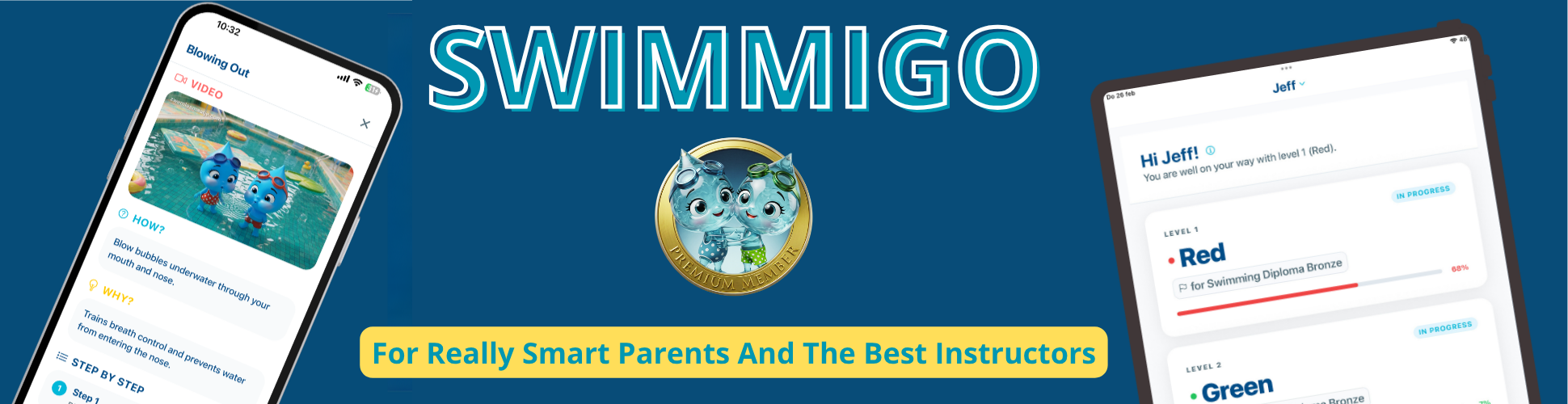
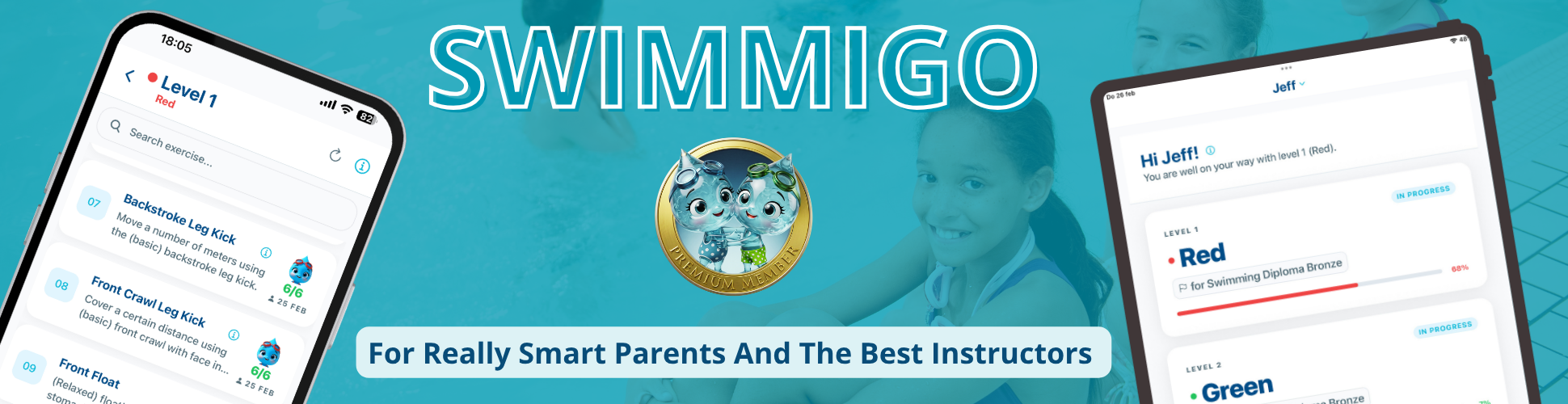
In the Swimmigo app, swimming schools track progress per skill, divided over seven levels from red to gold. The instructor ticks off which exercises a child masters, and parents see the same overview on their own phone. Such a list is exactly what a new school needs to place a child at the right level without guessing.
It also works the other way around. A swimming school receiving a transfer sees with such an overview in minutes where the child stands, instead of discovering after three lessons that the level is incorrect.
What a Child Can Do Counts in Every Country
This problem is not uniquely Dutch. Worldwide, an estimated 300 thousand people drown annually, and drowning is the fourth leading cause of death among children aged 1 to 4 and the third among children aged 5 to 14, reports the World Health Organization. Children under five make up almost a quarter of all drowning deaths.
Swimming skills are therefore a matter of safety in every country. In many countries without a national diploma system, a clear overview of skills is the only proof that a child can do something, whether they move from Amsterdam to Berlin or from Lyon to Madrid. Swimmigo is therefore available in five languages; a level overview works the same in every language.

Common Mistakes When Transferring
- Canceling at the old school before the new school has confirmed a spot; a waiting list can easily last a year.
- Choosing only based on price and distance, without considering group size, method, or how the school communicates.
- Not bringing progress records, forcing the new school to discover what the child can do from scratch.
- Switching during a dip without first discussing it with the current school.
- Not evaluating after the transfer; even a new school deserves to be assessed after a few months.
Conclusion
Switching to another swimming school is exciting but does not have to mean losing progress. Diplomas remain valid and a good school determines entry with a skills intake. Bring a progress overview, ask your questions, and give your child time to get used to it. Then a new school becomes a new opportunity instead of a step back.
Sources
- Statistics Netherlands: Moving, population dashboard (figures 2025 and 2026, consulted September 2026)
- Dutch House of Representatives: Parliamentary document 36 473, no. 3, Swimming Skills Act, explanatory memorandum (November 2023)
- National Council for Swimming Safety: Zwem-ABC and other National Swimming Diplomas (consulted September 2026)
- Mulier Institute via National Council for Swimming Safety: Swimming Skills 2020, swimming diploma possession of children (February 2022)
- World Health Organization: Drowning, fact sheet (May 2026)
- Zwemschool Utrecht: Changing swimming schools (consulted September 2026)

Bob van Soest
As an expert in operating sports facilities (such as swimming pools) and developer of, among others, Swimmigo.com, I am passionately committed to making swimming lessons simpler, more fun and more insightful for parents, swimming instructors and everyone who wants to learn to swim.
Frequently Asked Questions
Related articles

Why Showering Before Swimming Lessons Is So Important
Why shower before swimming lessons? Discover why hygiene and preparation are crucial for the best swimming experience. Read our tips and avoid surprises!
When to Start Swimming Lessons for Optimal Progress
Read from which age swimming lessons are effective for the best results and safety of your child in the water.

Effectively Registering Swimming Lesson Progress from What Age?
Discover from what age you should best register swimming lesson progress and how to do this practically.
Discover Swimmigo
The all-in-one app for swimming lesson progress. For parents, swim schools, and adult swimmers.